Article
Desk-side storage that does not become clutter

Desk-side storage fails in public: a beautiful cart arrives, then becomes a vertical junk drawer you glance at all day. Clutter in peripheral vision is still clutter. It taxes attention even when you swear you are used to it.
This guide shows how to add storage that stays useful—reachability without a junk skyline. It is practical home-office layout advice, not a shopping spree.
At a glance
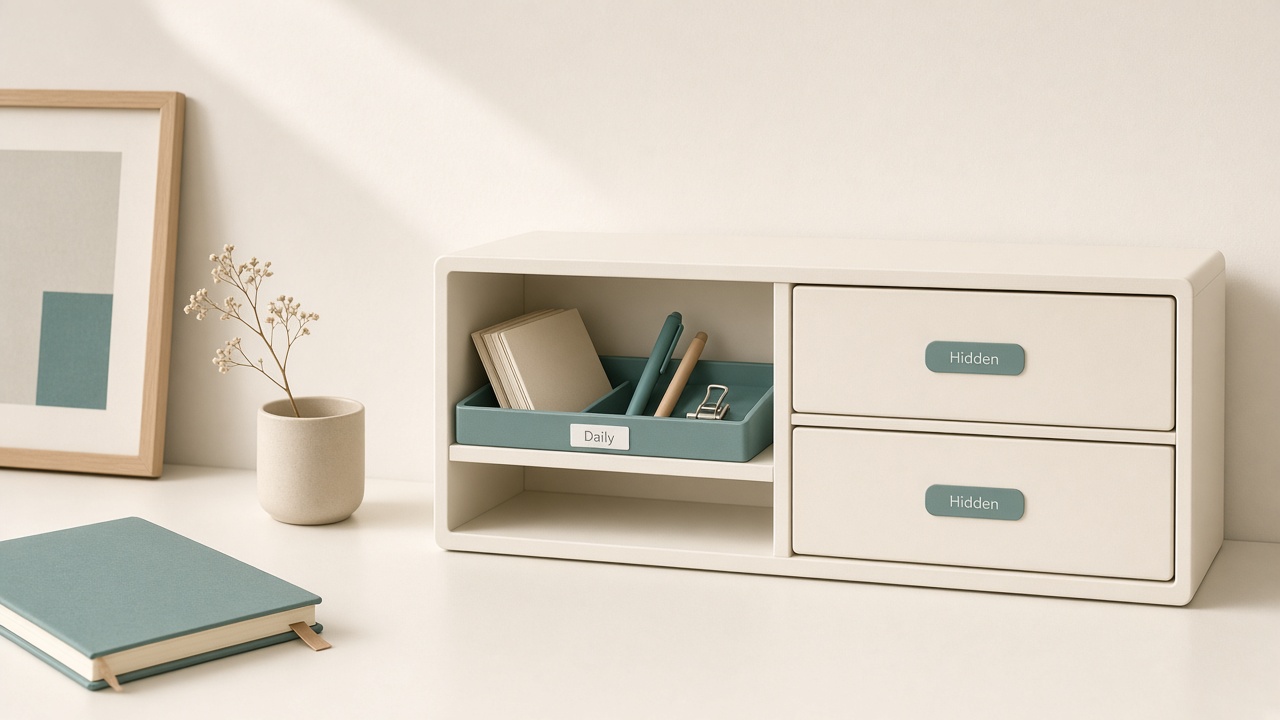
Daily tools open; clutter stays closed.
Storage should answer one question
Before you buy a shelf, name the job. Daily tools belong within seated reach. Weekly tools belong within one stand-and-grab. Dead storage belongs out of the work zone entirely.
If an object is neither daily nor weekly, it does not deserve desk-side real estate. Seasonal cables and old notebooks can live in a closet bin.
Prefer closed over open for anything ugly
Open shelves display intention—and also USB chaos, supplement bottles, and tangled chargers. Use closed storage for cables and dongles, snacks, random stationery, and backup peripherals.
Use open storage only for objects that are calm to look at and truly frequent: a current notebook, one pen cup, maybe a plant that is actually alive. If you love open shelves, give them a one-bin rule: each open cube contains one closed box. You keep the architecture and hide the noise.
Vertical beats sprawling
Small rooms run out of floor before they run out of height. Good desk-side patterns include a narrow drawer tower beside the dominant hand, wall shelves starting above monitor height for reference books, a pegboard or rail for headphones and often-used cables, and a rolling cart that can leave the room when you need space.
Avoid wide low bookcases that push your chair into a corner and create a second desk surface for pile-ups.
The reach map
Sit in your normal posture and draw three arcs. The primary arc keeps elbows near ribs for keyboard, mouse, pen, and water. The secondary arc allows a lean or half-turn for notebook stack, headphones, and lamp controls. The tertiary arc requires standing for printer paper, spare HDMI, and mailing supplies.
Daily tools that live in tertiary range will migrate onto the desk and stay there. Design honesty beats wishful minimalism.
Container rules that prevent junk drawers
Inside any drawer, use at most three trays or boxes. Categories might be connect for cables, write for stationery, and care for cleaning cloths. When a fourth category appears, promote it to its own home or delete it.
Apply a one-in, one-out rule for peripherals. When a new mouse arrives, the old mouse leaves the desk-side zone the same day. Storage is not a museum of maybe-weekend devices unless you truly use them weekly.
Label cable boxes by purpose: video, power, audio. Future troubleshooting should take thirty seconds, not an excavation.
What to keep on the desk surface
Aim for a small permanent set: computer or monitor, input devices, lamp, current notebook with one writing tool, and water. Everything else earns a home within secondary reach.
If temporary objects stay three days, they are permanent. Assign storage or remove them.
Carts, credenzas, and under-desk drawers
A rolling cart works well for craft-adjacent work and shared apartments. Park it out of sightline during deep work if it accumulates visual noise.
A credenza behind you is excellent for closed storage and poor if it becomes a dumping ledge in camera view. Keep the top clear for calls.
An under-desk drawer is perfect for daily bits and dangerous if it becomes infinite because you never see the mess. Schedule a monthly empty.
Weekly five-minute reset
Storage systems die without a tiny ritual. Clear the desk surface back to the permanent set. Return secondary tools to their containers. Trash packaging and dead pens. Recycle papers that were sorting piles.
Friday after a planning block is a natural slot. Pair habits so neither needs willpower alone.
Shared desks need named zones
If two people share a station, label shelves with names or roles such as “A cables” and “B stationery.” Shared anonymous drawers become conflict magnets and overflow onto the desk. A small caddy per person that leaves with them after a shift beats one mysterious communal abyss.
Starter kit under a small budget
You do not need custom millwork. A workable starter stack is one narrow three-drawer tower, two small lidded boxes for cables and stationery, a handful of large labels, and optional peg hooks for headphones.
Spend first on containers that close. Aesthetic open shelving can wait until daily tools have honest homes—and until you prove you will reset weekly.
Camera-facing storage and rental constraints
If your desk faces a wall on calls, keep that wall calm: closed cabinets, a plant, or empty space beat a pegboard of dangling adapters. Store the ugly useful gear beside or behind the camera axis. Colleagues should see a workplace, not cable archaeology.
In apartments and rentals, use freestanding towers instead of drilling when needed. Tension rods and over-door organizers can hold headphones and hoodies outside the visual field. Avoid towering stacks on thin desks that flex—put heavy paper storage on a floor tower, not the desktop. Keep heavy items low and anchor tip-prone shelves if you have kids or pets.
Checklist
- Daily / weekly / dead storage categories defined
- Ugly items moved to closed containers
- Vertical storage chosen over wide sprawl where space is tight
- Reach map tested from the working posture
- Drawer limited to three internal trays
- Cable box labeled by purpose
- Desk surface reduced to permanent set
- One-in, one-out rule for peripherals
- Five-minute weekly reset on the calendar
FAQ
Are desktop organizers worth it?
Small ones, yes—if they reduce surface scatter. Large multi-tier organizers often become clutter sculptures. Prefer a shallow tray plus a drawer.
What about open aesthetic shelves for vibes?
Keep them away from the primary monitor sightline. Vibes behind you on camera are optional; vibes in your forward field cost attention.
How many pens do I need desk-side?
Two that work. The rest are supplies—drawer or closet.
Should files live beside the desk?
Only active project files. Archive elsewhere. Paper expands to fill romantic filing carts.
Can plants count as storage partners?
Plants are atmosphere, not storage. Do not let pots colonize the secondary reach zone needed for tools unless you are intentionally trading tools for greenery.
Next reading
- Small-room home office layout
- Two-zone apartment office without a spare room
- A 20-minute weekly workspace reset
Storage succeeds when it disappears into habit. If you can see every object you own from the keyboard, you do not have storage—you have an audience.