Article
Two-zone apartment office without a spare room

Studio and one-bedroom apartments rarely offer a dedicated office. What they can offer is two zones: one for focus work and one for shallow admin, even when both zones live in the same room. The trick is furniture boundaries and behavioral rules, not a construction permit.
This guide is for renters who need remote-work structure without a spare bedroom.
At a glance
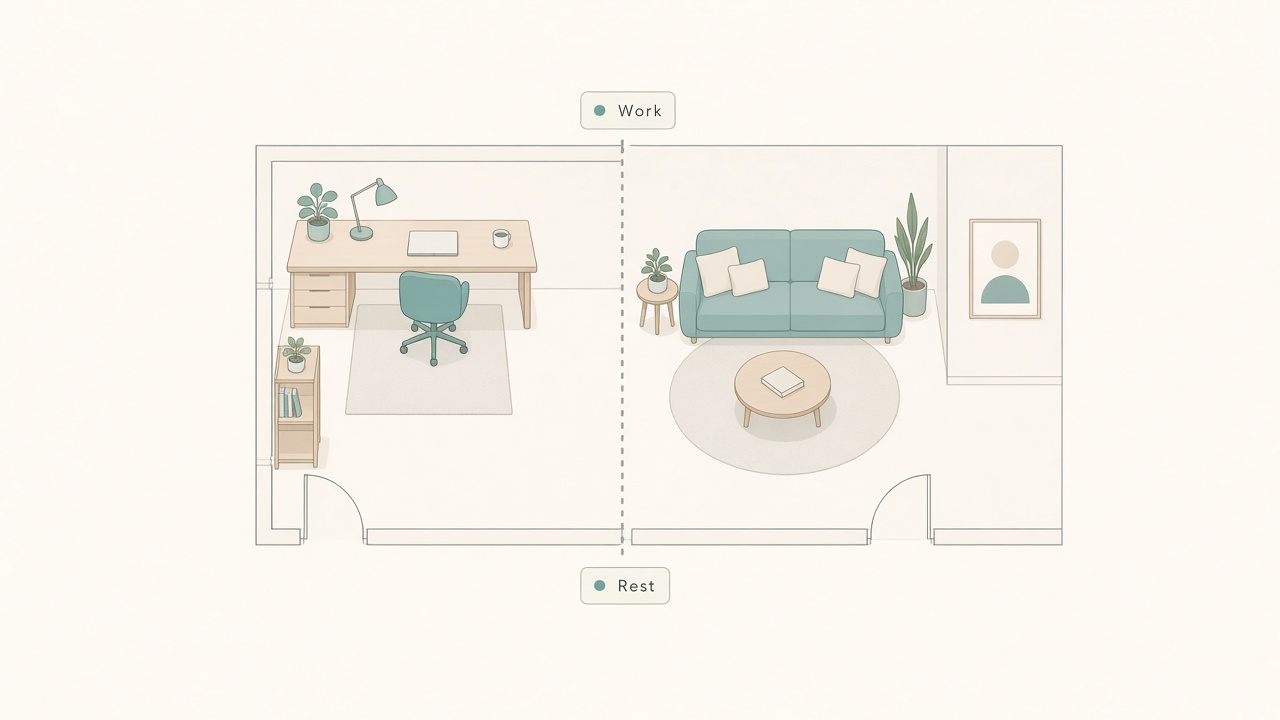
Separate work and rest zones in one room.
Why one ambiguous desk fails in small homes
When the same surface hosts deep writing, package wrapping, snacking, and evening movies, your brain never gets a clean mode-on signal. You sit down and inherit yesterday’s clutter and tonight’s entertainment residue. Two zones create contrast through different sightlines, different allowed objects, and different default tasks.
Zones can be only a few meters apart. Distance helps, but differentiation matters more.
Define the two zones by job, not by furniture catalog
Zone A is Focus: create, code, write, and analyze. Keep visual noise minimal. Phone parking can be optional, but it should be intentional.
Zone B is Admin: mail, printing, charging, return labels, and quick calls that need pacing. If you only have one table, Zone B can be a wall shelf, a rolling cart, or one end of a dining table that is cleared nightly. Do not demand two perfect desks before you start.
Boundary tools that landlords tolerate
Rug edges under Zone A tell your feet which mode you entered. A bookcase or open shelf can act as a partial screen that breaks sightlines to the bed or kitchen without blocking light. A curtain on a tension rod creates a soft wall for video backgrounds and psychological separation. A rolling cart becomes a mobile Zone B that docks beside the entry or kitchen. Lamp contrast helps too: cooler or brighter task light in Zone A, warmer dimmer light in Zone B and living areas after hours.
Avoid irreversible drilling when tension rods, freestanding shelves, and clamp lamps will do.
Layout patterns for studios
Pattern 1: window focus, wall admin
Put Zone A perpendicular to the window for daylight without screen glare. Park Zone B on an interior wall for chargers and clutter that would otherwise colonize the focus desk.
Pattern 2: bed screen
Place a low bookcase between bed and Zone A. Sleep views during work hours quietly erode mornings. Even a partial screen helps.
Pattern 3: dining dual-use with strict reset
Zone A becomes a portable monitor and laptop on the dining table during work hours. Zone B is a cart. At shutdown, everything returns to the cart and a wall mount so the table becomes dinner without negotiation.
Choose one pattern and write the shutdown steps on a sticky note. Ambiguous dual-use fails in the evening when you are hungry and tired.
Object rules keep zones honest
Zone A may contain the computer, one notebook, water, a task lamp, and the current project only. Zone A may not become storage for mail piles, toolkits, supplements, random cables, or laundry.
Those belong in Zone B or elsewhere. When Zone A grows a second life as storage, the zoning project is already over.
Sound, privacy, and daily choreography
Two zones will not soundproof a studio. Add soft materials such as a rug, curtain, or upholstered chair near Zone A to cut harsh reflections on calls. Use headphones as a household signal. Agree with housemates or partners on focus windows that are short and realistic rather than all-day silence demands.
For video calls, face Zone A’s camera toward the calmer background and keep Zone B’s visual clutter off-frame.
A useful daily rhythm starts in Zone A with one named artifact, batches admin to Zone B at set times, ends with a five-minute reset that clears Zone A and docks the cart, and leaves Zone A dark after hours so the apartment becomes home again. The dark desk is a boundary as real as a door.
Budget order for zone-building
Clear surfaces and decide object rules first because that step is free. Add lamp and rug differentiation next. Then add a cart or shelf boundary. Add a curtain or taller screen only if privacy still fails. Consider furniture replacements last.
Buying two matching office sets for a studio usually adds bulk without adding clarity.
One-week experiment to validate the split
On days one and two, mark Zone A with tape corners and a lamp, move admin objects out, and work only create tasks there. On days three and four, stand up Zone B even if it is a tray table, and force all mail and charging into it. On day five, practice the five-minute shutdown twice, once at lunch and once at end of day. Over the weekend, adjust boundaries that failed, which are usually bed-in-view problems or kitchen clutter in the camera frame.
If you feel no difference after a week, the issue may be schedule noise rather than layout. Pair zones with batched communication windows. Layout cannot save an unbatched chat habit, but it reinforces one.
Cable and power planning for two zones
Give each zone a known power point. Avoid daisy-chaining one overloaded strip across the room with a trip hazard. Label chargers so Zone B does not slowly steal Zone A’s brick. If you use a sit/stand converter only in Zone A, keep its cable loop inside the focus rug edge so feet learn the boundary.
Checklist
- Zone A and Zone B jobs written in one sentence each
- Physical boundary chosen through rug, shelf, curtain, cart, or lamp contrast
- Object allowlist for Zone A enforced
- Admin batch times decided so Zone B has a schedule
- Shutdown reset kept under five minutes and practiced for a week
- Camera background faces the calmer side of the room
- After-hours Zone A lights turned off to reclaim the home
- Power points assigned without a room-spanning trip hazard
FAQ
Can the sofa be Zone B?
Yes for phone calls and light reading of mail. Avoid making the sofa Zone A for daily deep work if it wrecks posture and sleep associations. If it is truly your only option, use a lap desk briefly and return to a table for longer sessions.
What if roommates need the dining table at random times?
Favor a rolling Zone A with laptop and portable display plus a wall dock, or a fold-down wall desk rated for your setup. Social calendars beat perfect layouts.
Is a room divider worth it?
If it blocks light and makes the studio feel smaller, maybe not. Try a partial-height shelf first. Full dividers help only when privacy pain exceeds spatial cost.
How do I zone a hotel-like micro-apartment?
Use vertical storage, a cart, and a strict shutdown. Zones can be desk mode versus cart mode on the same square meter if rituals are crisp.
Will two zones replace leaving the apartment?
Not always. Cafe or coworking days still help some people. Zones reduce friction on ordinary weekdays; they are not a personality transplant.
Two zones succeed when jobs, objects, and shutdown rules stay distinct. Start with free boundaries, protect Zone A from storage creep, and let the dark desk end the workday.