Article
A deep-work morning routine for remote workers

Remote mornings fail in quiet ways: you open chat “just to check,” answer three pings, and the deep-work block evaporates before coffee cools. A useful routine is not a motivational speech. It is a repeatable sequence that protects the first stretch of cognitive energy.
This guide is for people who already have a desk and a calendar—not for lifestyle redesign. The goal is a first ninety minutes you can run on ordinary weekdays.
At a glance
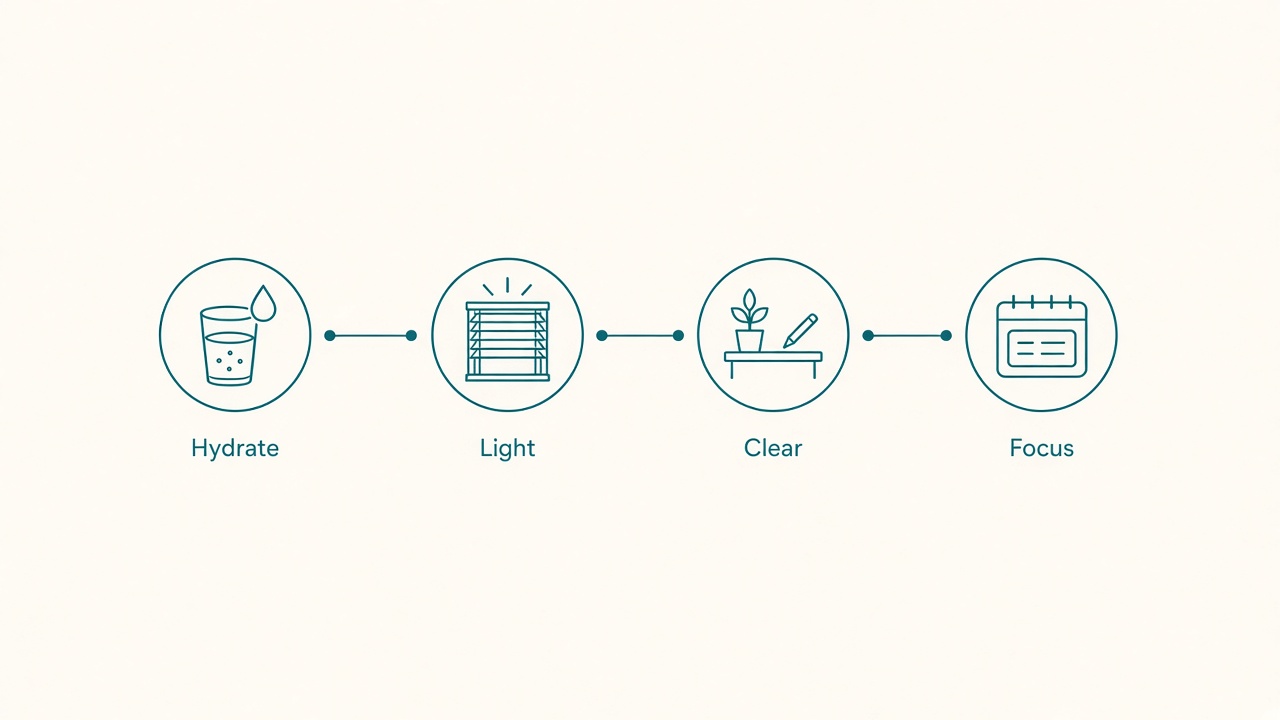
Hydrate, light, clear, then the first focus block.
What the first ninety minutes are for
Protect one outcome: one meaningful work unit finished or firmly advanced before reactive work starts. That unit might be a draft section, a bug fix, a design exploration, or a research memo. It should be concrete enough that you can say “done enough for now” without debating identity.
If your job is meeting-heavy, the morning routine still matters. You are buying a buffer before the calendar owns the day.
Minutes 0–10: environment before apps
Do not open the inbox yet. Open curtains or turn on a bright lamp so the room leaves half-sleep darkness. Spend two minutes on a desk geometry quick check—chair height, keyboard reach, and monitor distance—so fidgeting does not consume the block later. Clear yesterday’s cups and loose cables from the primary sightline; clutter is a soft interruption. Exile the phone to airplane mode or another room; if you need it for two-factor authentication, keep it face down outside arm’s reach.
This block feels petty until you notice how often a “quick phone check” becomes twelve minutes of unrelated scrolling.
Minutes 10–15: choose the one unit
Write the unit on paper or a sticky note in one sentence, such as drafting the pricing FAQ section to a readable first pass. A good unit is completable or clearly advanceable in 60–75 minutes, does not require three other people to unblock you first, and has an obvious artifact—a file, pull request, outline, or spreadsheet tab.
If you cannot name the artifact, you do not have a unit yet. You have a vibe.
Minutes 15–75: deep-work block
Open only the apps required for the unit. Close chat, email, and social tabs. If closing feels unsafe, set chat to offline or do-not-disturb with a status that names a return time. Start a single timer for 50–60 minutes; the timer is a boundary, not a productivity religion.
When a new idea appears, park it in a capture note rather than chasing it. When you feel the urge to check messages, wait until the timer ends; urgency is often social rather than operational. If you stall for more than three minutes, shrink the unit: write the ugly outline instead of perfect prose.
If you have a sit/stand desk, a short stand for the first half can reduce sluggishness. Do not make standing the point; the point is the artifact. Use a gentle rotation later with the standing desk schedule builder if you like structure.
Minutes 75–90: close the loop
Most people skip this segment, which is why mornings feel unfinished. Save artifacts in the canonical place—repository, document, or task tracker. Write a two-line handoff to future you describing what is done and what is next. Open communications on purpose as a scheduled gate, not as a leak. Scan for true fires only; everything else becomes a batch list for mid-morning.
If you dive into chat without the handoff note, the deep work evaporates psychologically even when the file exists.
A realistic weekday template
| Time | Action |
|---|---|
| 0:00 | Light, water, desk reset, phone away |
| 0:10 | Name the one unit and artifact |
| 0:15 | Deep-work timer (50–60 min) |
| 1:15 | Handoff note and save |
| 1:25 | Open chat and email deliberately |
| 1:30 | Transition to scheduled work |
Adjust clock times to your life. Keep the sequence.
Common failure modes
Treating email as a warm-up is a common failure. Email is a context-switch factory. If your job truly requires overnight incident scanning, create a five-minute emergency pass with a checklist, then start the unit; do not browse.
Claiming that the best ideas happen in chat is another failure mode. Schedule chat later. Ideas that exist only in scrollback are a dependency on noise, not a strategy.
If sixty minutes feels impossible, start with twenty-five minutes for two weeks. Protect the ritual first; length can grow after the sequence is automatic. If meetings start at 9:00, run a compressed forty-five-minute version: five minutes environment, five minutes unit selection, thirty minutes deep work, five minutes handoff. Something is better than surrendering the whole morning.
Adapt the ritual to household and travel days
Household mornings need the same sequence with tighter logistics. Complete environment setup the night before when you can: water on the desk, lamp position known, phone charger outside the work zone. If school drop-off owns the early clock, treat the first deep block after return as your “morning,” and keep the unit selection sticky note ready so decision fatigue does not eat the shortened window.
Travel and cafe days should preserve the unit and the handoff even when the desk disappears. Choose a smaller artifact, use noise-blocking headphones, and still write the two-line handoff before opening chat. The ritual is the sequence, not the furniture.
On days after a broken streak, do not redesign the whole system. Run the shortest viable version once, then return to the standard ninety minutes the next weekday. Recovery favors repetition over reinvention.
Checklist
- Phone out of reach
- One-sentence unit with an artifact
- Only required apps open
- Timer running
- Capture list for distractions
- Handoff note written before chat opens
FAQ
Does this work if I am not a morning person?
Yes. Morning means the first deep block of your workday, even if that is noon after school drop-off.
Should I drink coffee before or during the block?
Whatever keeps you from fidgeting. Do not let coffee prep become a twenty-minute procrastination ceremony.
What if my manager expects instant replies?
Align expectations with a visible status and response window. A routine that your workplace forbids will not stick—negotiate a short protected window or place the deep block where the culture allows it.
Can I listen to music?
If lyrics hijack language tasks, use instrumental audio or silence. Test for a week; do not theorize.
What if emergencies routinely break the first block?
Keep a short emergency pass with a written checklist, then restart the unit or protect a later deep block the same day. Chronic true emergencies are a staffing or escalation-design issue, not a failure of the timer.
Next reading
Protect the first artifact of the day. Everything else can be managed. The first artifact usually cannot be recovered after a morning of fragments.
Related tools: standing desk schedule