Article
Footrest vs lowering the chair

Dangling feet at a fixed desk are a geometry problem, not a shopping problem. The useful question is whether the chair can drop until both feet plant flat without breaking your typing angle. This guide walks through that decision in order: lower the chair when you can, add a footrest when the desk forces a higher seat, and treat unstable “patches” as temporary only. It is educational setup advice, not medical advice.
At a glance
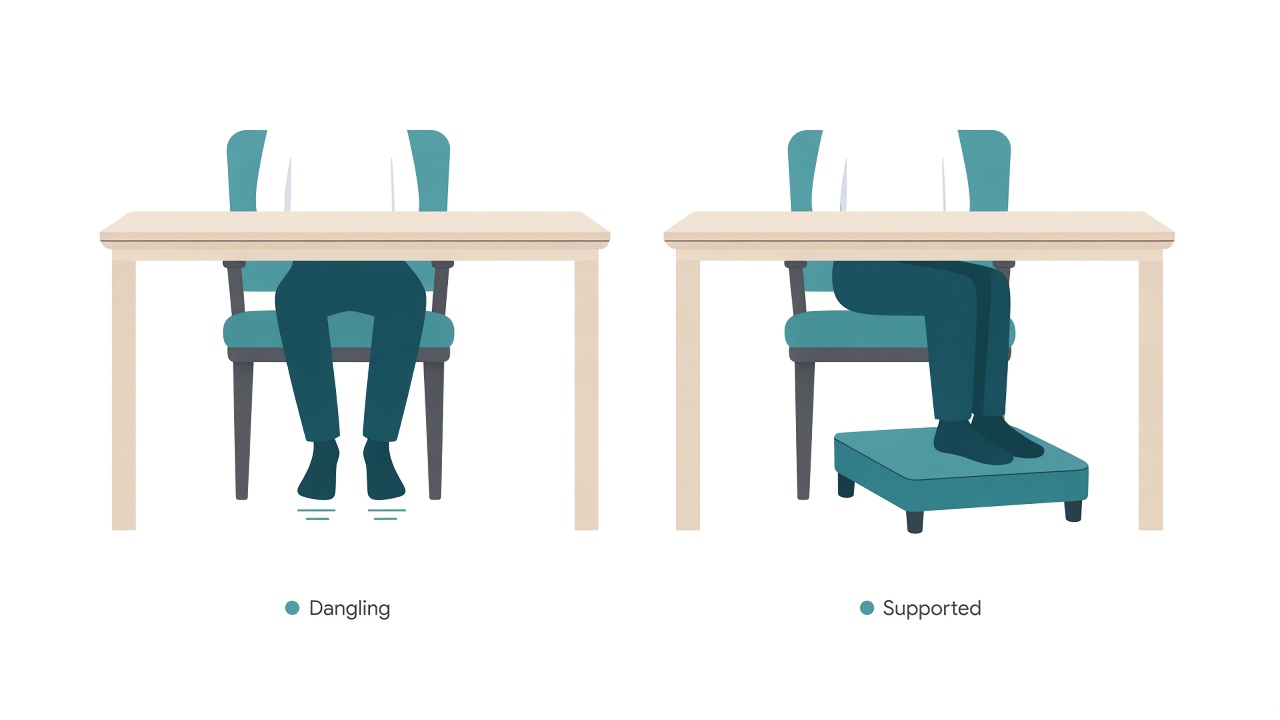
Support dangling feet or lower the chair when you can.
Why feet leave the floor in the first place
A workstation has three linked heights: seat, desk surface, and keyboard. When the desk sits high relative to your body, people often raise the chair so elbows can meet the keyboard. That move restores the forearm angle and simultaneously lifts the feet. Lowering the chair again plants the feet but recreates shrugged shoulders if the desk never moved.
Shared apartments, dining-table desks, and office benches make this mismatch common. The furniture is fixed; your proportions are not. Accessories help only when they restore a coherent stack—feet supported, hips roughly level with knees, and forearms near desk height—rather than when they decorate one symptom.
Quick decision tree
Work the options in this order before you buy anything.
- Lower the chair until both feet plant flat. Keep the seat deep enough that you are not perching on the front edge. Recheck elbows at the keyboard.
- If lowering the chair makes the desk feel too high—shoulders rise while typing, or wrists bend upward to reach the keys—raise the chair again and add a footrest, or lower the desk if it moves.
- If every chair setting leaves the desk too high, a footrest is a patch on top of a high seat. The durable fixes are a desk that can drop, a keyboard tray that lowers the keys, or a taller seat paired with stable foot support.
- If feet plant easily and elbows already look calm, you do not need a footrest. Skip the purchase.
Use the desk height calculator to estimate a keyboard target before you treat accessories as the primary lever.
When a footrest is the right tool
A footrest earns its place when the desk height is already near a workable elbow line and the chair must stay relatively high so forearms stay level. In that case, the feet simply cannot reach the floor without collapsing the typing posture you just fixed.
Choose a firm, wide platform that does not compress into a wedge under one foot. Soft pillows and folded blankets shift during the day and invite one-sided perching. Adjustable angle helps some people; stability matters more than fancy features. Both feet should share load. Knees should stay roughly level with hips rather than hiked toward the chest.
Place the footrest so your heels and forefeet can rest without sliding the chair backward. After installation, type for ten minutes and watch the shoulders. If they climb, you solved the feet and recreated a high-desk problem—adjust chair or desk next, not footrest thickness alone.
When a footrest is the wrong fix
A footrest cannot rescue a setup where you perch on the seat edge to reach the desk. That posture usually means the whole station is too far forward or too high, and foam under the shoes only hides the reach. Upward wrist bend while typing likewise points at keyboard height, not at missing foot support.
Tiny, slick, or rocking platforms also fail the job. They create a second unstable surface while hips sit far above the knees. In those cases the primary mismatch is desk or keyboard height. Lower the keys, raise a tray, or change the desk before you add another object under your feet.
If lowering the chair works cleanly—feet flat, elbows calm, shoulders soft—stop there. Buying a footrest “because serious desks have one” adds clutter without improving the stack.
Lower the chair first: how to test it honestly
Sit back in the chair rather than on the front lip. Drop the seat until both feet rest flat on the floor or on a stable mat. Check knee height relative to hips; slight variation is fine, extreme hiking or dangling is not.
Return your hands to the home row. Forearms should sit roughly parallel to the floor or with only a mild downward slope toward the keys. If shoulders shrug or wrists extend sharply upward, the desk or keyboard is still too high relative to this new seat height. Raise the chair again and move to the footrest path—or change the desk if you can.
Repeat the test after lunch and after any cushion compression. Soft seats sink over months and quietly recreate dangling feet even when the original setup was sound.
Desk and keyboard moves that beat another accessory
When the desk adjusts, prefer dropping the work surface to match a chair height that already plants the feet. That single change often removes the need for a footrest entirely. When the desk is fixed, a keyboard tray that lowers the keys can restore elbow angle without forcing a sky-high seat.
External keyboards also help on laptop-as-monitor days: the screen can sit higher while the keys stay at elbow height. Do not stack a footrest under a chaotic reach pattern and call the station finished. Geometry first; accessories second.
Cable trays, thick mats, and storage bins under the desk sometimes block a proper footrest. Clear the kickspace before you conclude that “footrests do not work for me.” The platform needs room, not a fight with a surge strip.
Shared and temporary desks
Hot desks and meeting-room tables rarely offer perfect height. Carry a thin, firm portable footrest only if your usual sites leave feet dangling after you set the best available chair height. Otherwise prioritize an external keyboard and a quick elbow check; those travel better than a bulky platform.
At home, mark the preferred chair height with a piece of tape once you find it. Partners and guests raise seats without noticing. A visible mark turns tomorrow’s reset into a five-second task instead of another dangling-feet afternoon.
Checklist
- Tried lowering the chair until both feet plant before shopping
- Rechecked elbow angle at the keyboard after any seat change
- Chose a firm, stable footrest only when the desk forces a higher seat
- Kept both feet sharing load; avoided one-foot perching
- Kept knees roughly level with hips on the platform
- Cleared under-desk clutter so the footrest sits flat
- Ran a 10-minute typing test and watched for shrugged shoulders
- Used desk drop or keyboard tray when accessories alone cannot fix height
- Rechecked seat height after cushion compression or shared use
FAQ
Is a footrest better than lowering the chair?
Neither is universally better. Lower the chair when feet can plant without ruining elbow angle. Add a footrest when the desk requires a higher seat to keep typing geometry workable.
Can I use a box or books instead of a commercial footrest?
Yes for a short trial if the stack is wide, non-slip, and stable. Replace improvised stacks that rock or compress unevenly. A trial stack is a measurement tool; it is not automatically a long-term surface.
What if my feet dangle only after I raise the chair for under-desk clearance?
Clear the kickspace first. Storage bins and thick mats often force an unnecessarily high seat. Restore clearance, then reassess whether you still need a footrest.
Do I need an angled footrest?
Angle is optional. Many people do well on a flat, firm platform. Choose angle only if it helps you keep heels supported without sliding; do not chase steep angles that hike the knees.
Will a footrest fix upward-bent wrists?
No. Upward wrist bend usually means the keyboard is still too high relative to the elbows. Fix desk, tray, or chair height first. A footrest supports the feet; it does not lower the keys.
Related tools: desk height