Article
Focus music vs silence for deep work
Some remote workers swear by lo-fi playlists. Others need a quiet room or they cannot finish a sentence. Both camps are partly right, and both waste time arguing instead of running a short personal test.
This article gives you a practical protocol to decide when music helps, when silence wins, and how to keep audio from becoming another distraction loop. It is about attention at a desk, not taste in genres.
At a glance
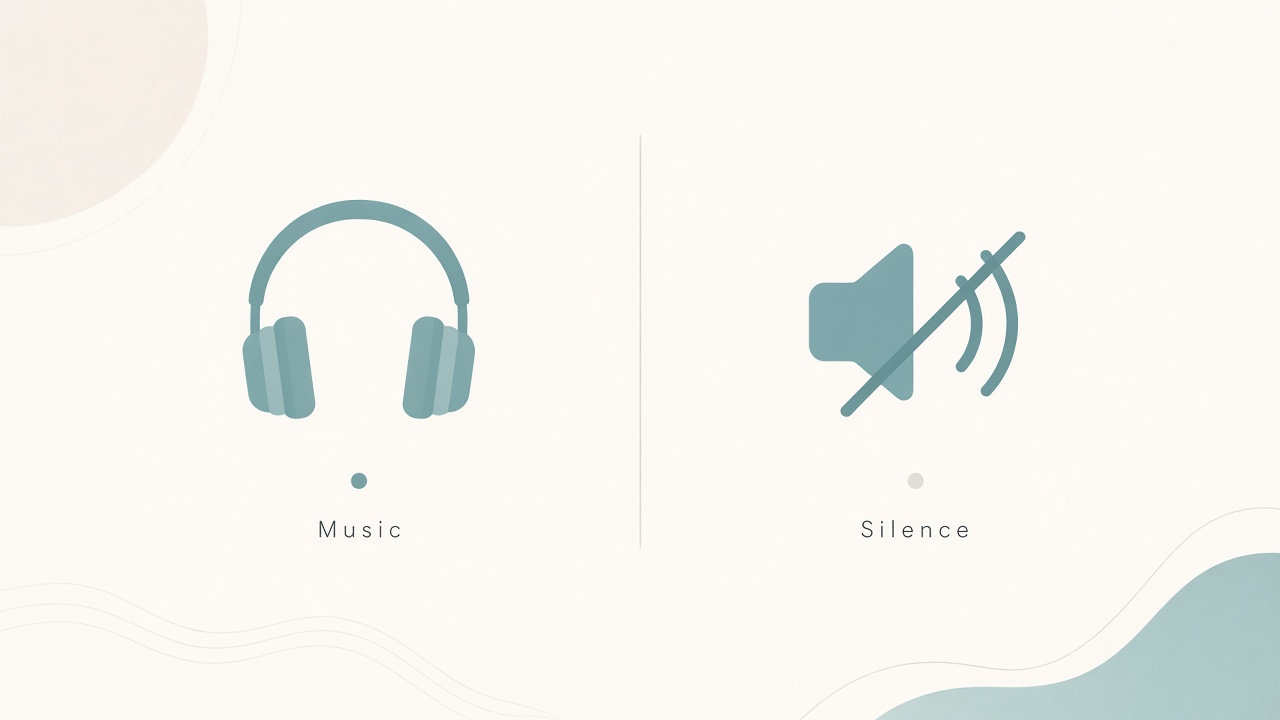
Match audio to the task—or choose silence.
The real question is not music or silence
The useful question is whether, for this task type, sound improves throughput or steals working memory.
Language-heavy work such as writing, editing, careful reading, and nuanced chat replies competes with lyrics and even with melodic hooks. Spatial or repetitive work such as inbox sorting, spreadsheet cleanup, simple design tweaks, and compile waits often tolerates or benefits from steady sound that masks household noise.
Treat audio as a tool with task labels, not a personality trait.
Build a two-week listening experiment
You do not need lab gear. You need honesty and a tiny log.
First, pick three task buckets in your own words: prose or code reasoning, shallow processing, and creative exploration. Second, for each bucket run at least two focused blocks of 35 to 50 minutes in silence or soft environmental noise only, and again with instrumental or ambient audio without lyrics. Add a familiar lyrical playlist as an optional third condition if you already use one. Keep volume moderate; if you cannot hear a soft knock, it is too loud for desk work.
After each block, score three numbers from one to five: output progress, intrusion count from fiddling with tracks, and restart cost after interruptions. Average after two weeks. Patterns beat vibes.
When instrumental audio usually helps
Instrumental audio helps when it masks neighbors, street noise, or HVAC that otherwise pulls attention. It also works as a boundary cue when headphones signal that household chat should wait. Rhythmic or repetitive admin often benefits when silence feels sticky and restless.
Prefer long mixes or albums over algorithmic radio that surprises you with ads or sudden genre jumps. Surprise is the enemy of deep work.
When silence or near-silence usually wins
Silence usually wins for sentence-level writing where rhythm and wording matter, for learning new material you must paraphrase later, for pairing or calls where you already track voices, and for high-stakes review where a missed detail is expensive.
If silence feels harsh in a noisy apartment, try a fan or distant ambient bed without melody. Silence here means no competing structure, not absolute zero sound.
Lyrics, playlist hygiene, and desk cues
Lyrics recruit the language system. That can be motivating on a walk and costly in a draft. If you love lyrical music, park it for breaks, chores between blocks, and end-of-day shallow cleanup. Decide before the timer starts rather than negotiating mid-paragraph.
Audio fails most often through management, not melody. Choose the mix before you start. Cap length to one album or a timer-matched mix. Disable autoplay into related mixes if you tend to hunt. Use the same work playlist for a month so novelty dies down. Wire headphones once so tangled dongles do not become fake urgent tasks.
If you spend five minutes finding the perfect track, the music already lost. Closed-back headphones or well-fitted earbuds mark a clearer household boundary than open-back designs that leak sound. Keep volume low enough that intentional calendar chimes still register. Place the phone face down so lock-screen lyrics do not become micro-checks.
A sample week after the experiment
Use sample assignments only after your two-week log exists. Until then, they are hypotheses. Try silence or brown noise for Monday create blocks, a prechosen instrumental mix for Monday admin, silence-first debugging with ambient only if neighbor noise spikes, familiar instrumental audio for Wednesday shallow chores, silence with lyrics banned for Thursday writing, and lyrical music as a Friday cleanup reward mode.
Review Friday afternoon: which assignments produced the least track-fiddling? Promote those to defaults for the next month. Demote anything that invited playlist surfing. If you share a household, post the week’s audio plan near the desk so headphones-on silence still reads as working, not available for podcast chat.
Edge cases worth planning for
In open offices and coworking spaces, silence is rarely literal. Prefer strong masking with zero lyrics and a known mix length. Novelty playlists in public spaces often become people-watching soundtracks.
For pair programming, match your partner. Dual soundscapes fight. Agree on quiet, or one shared low ambient bed at polite speaker volume.
On overload days, drop layered music entirely. Soft steady noise or quiet is enough. Do not force a branded focus soundtrack when simplicity is what you need.
For language learning or speech work, treat the task like prose: silence or non-linguistic noise only.
Keep the policy written and small
After the experiment, write a three-line audio policy and pin it near the desk. Example: prose defaults to silence, admin defaults to one instrumental mix chosen the night before, and lyrics are reserved for walks. A written policy prevents mid-block renegotiation when boredom arrives.
Revisit the policy monthly, not daily. Daily playlist reinvention is itself a distraction. Monthly review is enough to catch season changes in household noise or a role shift toward more writing or more admin.
Checklist
- Three task buckets defined in your own words
- At least two timed blocks per bucket in silence and in instrumental audio
- Simple 1-5 scores logged for progress, intrusion, and restart cost
- Default playlist chosen in advance for music blocks
- Autoplay and recommendation surfing disabled during deep work
- Lyrics reserved for breaks unless your log proves otherwise
- Household signal agreed if you share space
- Three-line audio policy written after the experiment
FAQ
Is branded focus audio better than plain ambient?
Not reliably for everyone. If you enjoy it and your log looks good, use it. If you feel obliged because marketing promised productivity, drop it and retest with simpler sound.
What if my office is quiet but my brain is loud?
Try a low-level non-lyrical bed for shallow work and strict silence for writing. Restlessness is sometimes caffeine, unfinished open loops, or lack of a clear artifact, not a missing playlist.
Can I use podcasts for deep work?
Usually no for language tasks. Podcasts are content, not wallpaper. Save them for walks unless the work is genuinely mechanical and requires almost no verbal thought.
Should I noise-cancel all day?
Constant heavy cancellation can feel isolating and make the moment you take headphones off more jarring. Use it for noisy stretches and planned deep blocks, not as a permanent seal.
How do I handle teammates who chat while I have headphones on?
Status text plus a visible cue beats hope. A short agreement that headphones mean batched replies at a named time prevents social friction better than any genre choice.