Article
An end-of-day shutdown ritual for remote workers

Remote work dissolves the commute that used to force a mental handoff. You close the laptop, walk twelve steps, and your brain keeps drafting replies over dinner. An end-of-day shutdown ritual is not aesthetic journaling. It is a short, repeatable sequence that parks open loops so evenings belong to something else.
This is a productivity and boundary practice for desk workers. It is not advice about sleep disorders or clinical anxiety.
At a glance
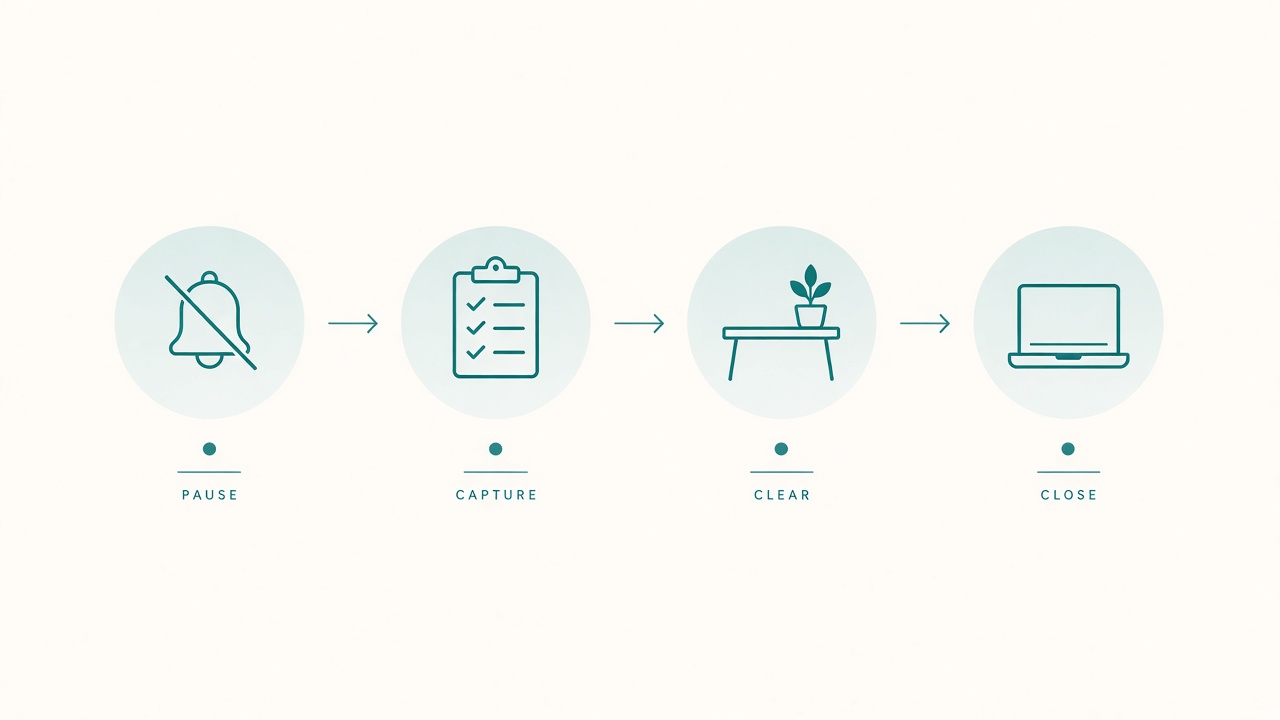
Pause, capture, clear, close—then leave work behind.
What shutdown is for
A useful shutdown does three jobs. It captures unfinished work so your mind does not rehearse it. It defines the first move for tomorrow. It separates work environment cues from home cues.
If your ritual only includes closing chat, loops stay loaded. If it only includes reflection with no capture, you still wake up reconstructing context. Aim for 10–15 minutes. Longer rituals get skipped on the days you need them most.
The twelve-minute remote shutdown
Minutes 0–2 stop intake. Pause notifications or enable focus mode. Do not open new email threads for a second. Stand up once, even briefly, to mark a posture change from work mode. A sit/stand swap can act as physical punctuation; if you use timed standing blocks during the day, treat the final sit as part of shutdown rather than an afterthought. Your schedule tool can keep daytime swaps honest so the last change feels intentional.
Minutes 2–6 park open loops. Open your task list or a plain note titled “Shutdown.” For each lingering mental tab, write one line with a next visible action, an artifact or place, and an optional due cue. Examples include drafting an intro paragraph in a named file before standup, asking a teammate for API limits in a morning message, or revising an invoice in a known folder by Friday.
Keep the lines concrete. Avoid vague nouns such as “finish project.” Write no more than one action per line. If a loop needs a calendar block, create it now while context is warm. This capture step is the heart of the ritual; everything else supports it.
Minutes 6–9 choose tomorrow’s first unit. Write a single sentence that names the first deep unit. Pick work that does not require three other people to unblock you early. Place the file path or link in the note so morning-you executes instead of negotiating identity.
Minutes 9–11 tidy the visual field. Close tabs you were only saving with guilt, or bookmark a session restore intentionally. Put cups, chargers, and random paper back to neutral homes. Dock the laptop or close the lid if that is your household cue. Visual residue is a remote-work leak; a clear desk makes the next morning cheaper.
Minutes 11–12 draw a boundary line. Say or write one closing sentence such as “Shutdown complete. Remaining items are parked.” Then leave the room or turn away from the desk. The sentence sounds cheesy until you notice how often you skip the leaving part.
Adaptations for messy realities
When a meeting ends at 5:58, run a five-minute emergency version: park the three hottest loops, set tomorrow’s first unit, and close the lid. Do the tidy pass after dinner if needed, but do not skip capture.
In a shared living space, use headphones-off plus lid-close as the signal if you cannot leave a room. Agree with housemates that after shutdown you are interruptible for home life, not half in chat.
Managers with chaotic evenings still benefit. Add a rule that after-hours pings go to a note for morning triage unless they meet a written definition of urgency.
Creatives mid-flow should capture the next stroke, such as continuing a scene from a specific line, so stopping does not feel like losing the work. Flow without a parking brake becomes avoidance of rest.
Common failure modes
Shutdown becomes useless when it turns into another productivity project, such as optimizing fonts in a journal template instead of parking loops. It also fails when you only shut down on clean days; dirty days need the ritual more, so use the emergency five-minute version.
Tomorrow’s first unit should not be a meeting. Meetings are calendar facts. Choose a deep unit before or after, or a prep artifact you control.
Browser sessions are fragile memory. Write the action in a note. If you reopen work at night, restart a mini capture before bed so the loop is not formless.
Pair shutdown with a morning handshake
Shutdown and morning routine are bookends. Morning should open the note, start the first unit, and only then open intake channels. If mornings still begin in chat, improve the morning gate; do not abandon shutdown.
Tools and tabs: a light digital tidy
You do not need a pristine digital life. You need tomorrow’s path to be obvious. Leave the task note pinned. Close duplicate docs you opened for comparison. Save unfinished drafts with names that include the next verb. Log out of shared household browsers if privacy matters more than cookie convenience.
Digital clutter is a remote-work version of leaving tools on the floor. A light tidy prevents stubbed toes in the morning.
When work returns after hours
Some roles include true on-call or executive exceptions. Define the exception in writing: what counts as urgent, where urgent pings appear, and how you re-enter shutdown afterward with a mini capture and next action. Without a definition, every notification feels eligible to reopen the day.
Weekly add-on for Fridays
Once a week, add five minutes. Scan parked loops older than seven days. Delete or re-park zombies. Note one system friction such as tool friction, meeting load, or unclear ownership. This prevents the shutdown list from becoming a graveyard.
Checklist
- Notifications paused before capture
- Open loops written as next visible actions
- Calendar blocks created for time-bound follow-ups
- Tomorrow’s first deep unit specified with artifact
- Guilt tabs closed or intentionally bookmarked
- Desk surface returned to neutral
- Laptop lid closed or work machine logged out as household cue
- Closing line spoken or written
- Physical leave or definite turn-away completed
- Friday zombie-loop scan scheduled
FAQ
What if I still think about work after shutdown?
That happens. The point is reducing unstructured rehearsal. If a new action appears, write it down quickly and return to the evening. Persistent sleep disruption is worth discussing with a qualified professional.
Should shutdown include inbox zero?
Only if your role truly requires it. Most people do better parking a few emails that need replies as actions rather than chasing an empty inbox late in the day.
Can I shut down mid-afternoon before school pickup?
Yes. Run the same capture sequence, then a second mini-shutdown if you return to work later. Multiple handoffs beat one fuzzy evening.
Is a paper notebook better than an app?
Whichever you will open tomorrow morning. Paper is constrained; apps are searchable. Consistency beats medium.
How do I handle unfinished deep work that feels emotionally loaded?
Park a specific next action, such as rewriting a paragraph around a customer objection. Specificity reduces nighttime abstract worry better than pep talk.
Related tools: standing desk schedule