Article
Desk stretch microbreaks you will actually do

Most desk stretch routines die because they look like a gym class squeezed between messages. You do not need a fifteen-minute mobility flow to feel better between focus blocks. You need microbreaks: thirty to sixty seconds, obvious triggers, and a tiny menu that does not require floor space or courage in an open room.
This article is general educational content about comfortable desk habits. It is not medical advice, diagnosis, or a treatment plan. If you have injuries, numbness, or ongoing pain, get personalized guidance from a qualified professional before copying anyone’s routine.
At a glance
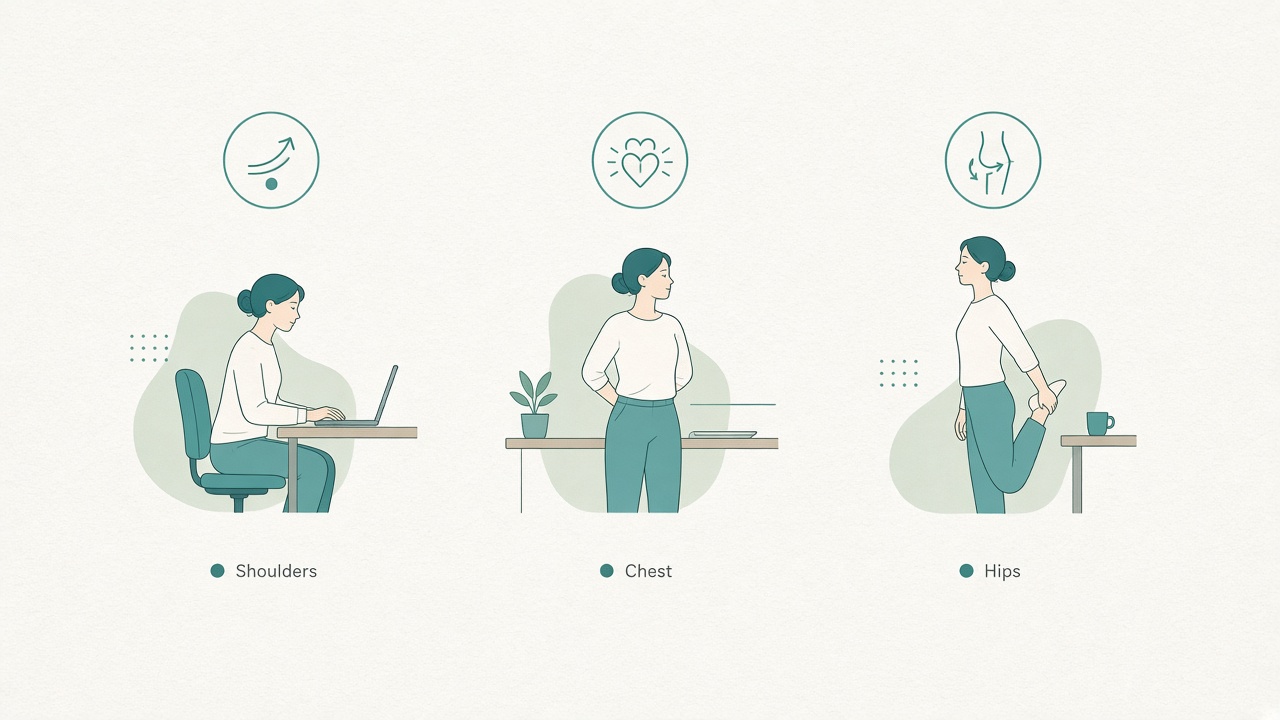
Short shoulder, chest, and hip resets at the desk.
Why microbreaks beat ambitious routines
Ambitious routines fail for predictable reasons. They require changing clothes or lying on the floor. They start only when discomfort is already loud. They compete with deadlines, so they lose.
Microbreaks win when they are boring, short, and attached to work events you already have—the end of a focus timer, a send button, a compile finish, a meeting end, or a sit/stand swap from your standing schedule.
Design rules for stretches you will repeat
Stay near the chair so you do not hunt for equipment. Keep the break under sixty seconds unless you are on a real break. Prefer gentle ranges and soften rather than force. Breathe normally; dramatic holds are unnecessary. Pick three defaults, not twenty options.
If a movement feels sharp, stop. Swap to a smaller range or skip it.
The three-zone microbreak menu
Rotate zones across the day rather than performing everything every time.
Zone 1 covers neck and upper back in about thirty seconds. Desk work parks your gaze forward and often slightly down. Sit tall, drop the shoulders, look left and right slowly without cranking, tuck the chin gently then release, and draw the shoulder blades slightly toward each other before releasing. Keep movements small enough that a coworker would barely notice.
Zone 2 covers wrists and forearms in about thirty seconds. Shake out the hands loosely, gently extend and flex one wrist with support from the other hand without forcing, spread the fingers wide then make soft fists, and rest the forearms on the desk with shoulders dropped. If wrists are sensitive, reduce range and check keyboard height later; stretches are not a substitute for a desk that is too high.
Zone 3 covers hips and legs in thirty to forty-five seconds. Stand and shift weight side to side, hinge gently at the hips with soft knees, circle the ankles while standing behind the chair, and take two slow march-in-place steps if privacy allows. Pair this zone with stand blocks when you have a sit/stand desk.
Trigger map: attach breaks to work, not willpower
Choose two triggers maximum at first. After sending a long email, use Zone 1. When a build or test finishes, use Zone 2. At each sit-to-stand transition, use Zone 3. At the end of a 25–50 minute focus timer, pick the zone you used least. When a meeting ends, stand and use Zone 1.
Write the map on a sticky note for five days, then remove it. If you need the note forever, the triggers are wrong for your job.
A sample day without looking conspicuous
After the first deep block, shake out the wrists and spread the fingers. During a standing call, shift weight in mute moments. After an inbox batch, turn the neck gently and squeeze the shoulder blades. Before the next deep block, stand, circle the ankles, and sit with feet flat. At shutdown, take two minutes of easy walking to another room.
Nothing here requires a mat in the hallway.
Mistakes that make microbreaks useless
Saving everything for evening mobility does not undo six uninterrupted hours of static posture. Stretching instead of fixing height leaves the root cause untouched. Treating sharp or tingling sensations as a progress metric is a stop sign, not a challenge. Choosing impressive public choreography creates shame spirals that kill consistency. Adding ten new movements every Monday creates novelty and abandonment instead of habit.
Combine with posture resets, not perfection
A microbreak is a reset, not a personality upgrade. Between breaks, still aim for supported feet, soft shoulders, a readable screen distance and size, and occasional standing or walking.
Think of stretches as windshield wipers. They help you see; they are not the engine.
A sixty-second full pass for heavy days
When you only have one chance between stacked meetings, run one short sequence. Stand behind the chair for five seconds. Squeeze and release the shoulder blades twice. Turn the neck gently for about fifteen seconds. Shake out the hands and spread the fingers. Shift weight or circle the ankles for about twenty seconds. Then sit or continue standing with soft knees.
One full pass beats skipping everything because you lacked time for a long routine.
Team-friendly options
If you manage remote or hybrid teams, normalize optional camera-off stretch minutes between stacked meetings. Avoid forcing group stretch culture that embarrasses people. Prefer optional prompts such as “stand if you want” over performative rituals. Protect calendar gaps that make microbreaks possible.
Culture beats posters.
Checklist
- Three-zone menu chosen and written once
- Two work triggers linked to zones
- Movements stay gentle and chair-adjacent
- Keyboard and desk height checked if wrists complain
- Stand swaps used as automatic Zone 3 cues
- No requirement for floor work during work hours
- Sharp-sensation rule understood: stop and seek advice if needed
- Sticky-note training plan for five days only
- Friday review: which trigger survived?
- Evening optional walk kept separate from the microbreak system
FAQ
How often should I take a microbreak?
Many desk workers do well with a short reset every 30–60 minutes, plus longer movement at lunch. Match frequency to how static your work is—not to an internet slogan.
Are standing desks enough without stretches?
Standing changes the load; it does not replace small movement. Static standing can be tiring too. Combine swaps with tiny mobility.
What if I forget constantly?
Attach breaks to digital events that already happen, or use a gentle timer. Do not rely on “feeling the need,” which arrives late.
Can I do these with a wearable reminder?
Yes, if the reminder is sparse. Constant buzzing becomes another notification to ignore. One or two cues per hour is plenty.
Should microbreaks replace exercise?
No. They are desk hygiene. Keep separate time for whatever broader fitness plan fits your life and professional guidance.
Related tools: standing desk schedule